Showing posts with label McKinlay. Show all posts

Thursday, 4 January 2024

Accentuate the positive - a reflection on my 2023 family history year

Jill Ball, aka GeniAus, puts out this challenge annually and I was thrilled when I saw the 2023 prompts published. I love stopping and reflecting on my research year, to remember great discoveries, see where my focus was for the year, and get re-enthused for the year ahead. Thanks Jill!!

On revisiting some old research I found ... so many details and clues overlooked in the original research frenzy to find records and information.  With time comes new context and I find there is always value in revisiting research and records – I’m often surprised to find I’ve missed something that, in hindsight, was the obvious next logical step.

 In 2023 I hooked up with a new (to me) living cousin ... I was very fortunate to travel to the UK this year and meet up with quite a few cousins of varying degrees who I’d “discovered” through research but only met through emails and Facebook up until then.  All were delightful and I enjoyed lunches, exchanges of information, weekends exploring cemeteries, and, in one case, viewing an extensive collection of family memorabilia dating back to the mid-1850s.

 I'm pleased I replaced a tool I had been using with  ... Family Echo. It’s the app I’ve been dreaming of for years.  A web-based platform, it enables you to very quickly create a family a tree to illustrate particular relationships - the kind of tree I often draw on the back of an envelope to explain something to Mum – but in digital format.  It doesn’t take the place of family history software such as FamilyTree Maker, RootsMagic or similar but is so useful to quickly create a diagram. You can input a range of basic biographical data, which can be exported in a range of formats including GEDCOM and .csv as well as pdf download of tree diagrams. Never been happier. And did I mention that it’s FREE!!

My sledge hammer did great work on this brick wall ... I think I used my butterfly net more than my sledge hammer this year; gathering up lots of new material that I can apply my sledgehammer to this year.

I was pleased that I finally read... The Curlews on Vulture Street. It has nothing at all to do with family history. But it is a great example of making research engagingly readable.

I enjoyed my geneajourney to ... The UK – Ireland, Scotland and England. I revisited some places and went to some new ones, mostly small out-of-the-way villages as well as a few archives and local history groups. I met up with cousins (see above) and spent time with the dearest person in my family tree - my daughter. 

In 2023 I finally met ... More amazing local historians and wonderful archivists. A particular shoutout to Billy and Margaret of the Dalmellington Local History Group who welcomed me into their rooms and shared their local knowledge (and some Bakewell tarts). It’s a tiny, out of the way village in rural Ayrshire (Scotland) to which I curiously have both a maternal and paternal connection. It required a train and a bus to get to but so worthwhile.  A timely reminder that (a) there is always value in reaching out the locals and (b) the importance of supporting these groups if you have an opportunity.

I was the recipient of genearosity from ... Family History Month, being the lucky winner of a Gould Genealogy book voucher that enabled me to add three books to my library. Although, embarrassingly, still on my TBR pile.

I am pleased that I am a member of ... Huddersfield and District Family History Society (Yorkshire, UK).  This group actively promotes their family history tourism services and go to extraordinary lengths to create bespoke local tours and coordinate access to buildings and places of significance in your family history. This year, I had a behind the scenes tour to Broadbent Engineering, where my gr-gr-grandfather did his apprenticeship circa 1870 and the Almondbury Grammar School where he went to school. I’ve also been fortunate that my membership with the group has netted other research results. And, even better, I’ve been able to reciprocate by assisting them with some research in Australia.

I made a new DNA discovery  ...  not this year!

An informative journal or newspaper article I found was ... one that had been lurking in my files for many a year, provided by a fellow researcher, that described the diamond wedding anniversary of the younger brother of an ancestor and included valuable clues to further exploration of this collateral line.

A newspaper archive (Papers Past) helped me ...  add a few details to what we know of an ancestor’s brother.
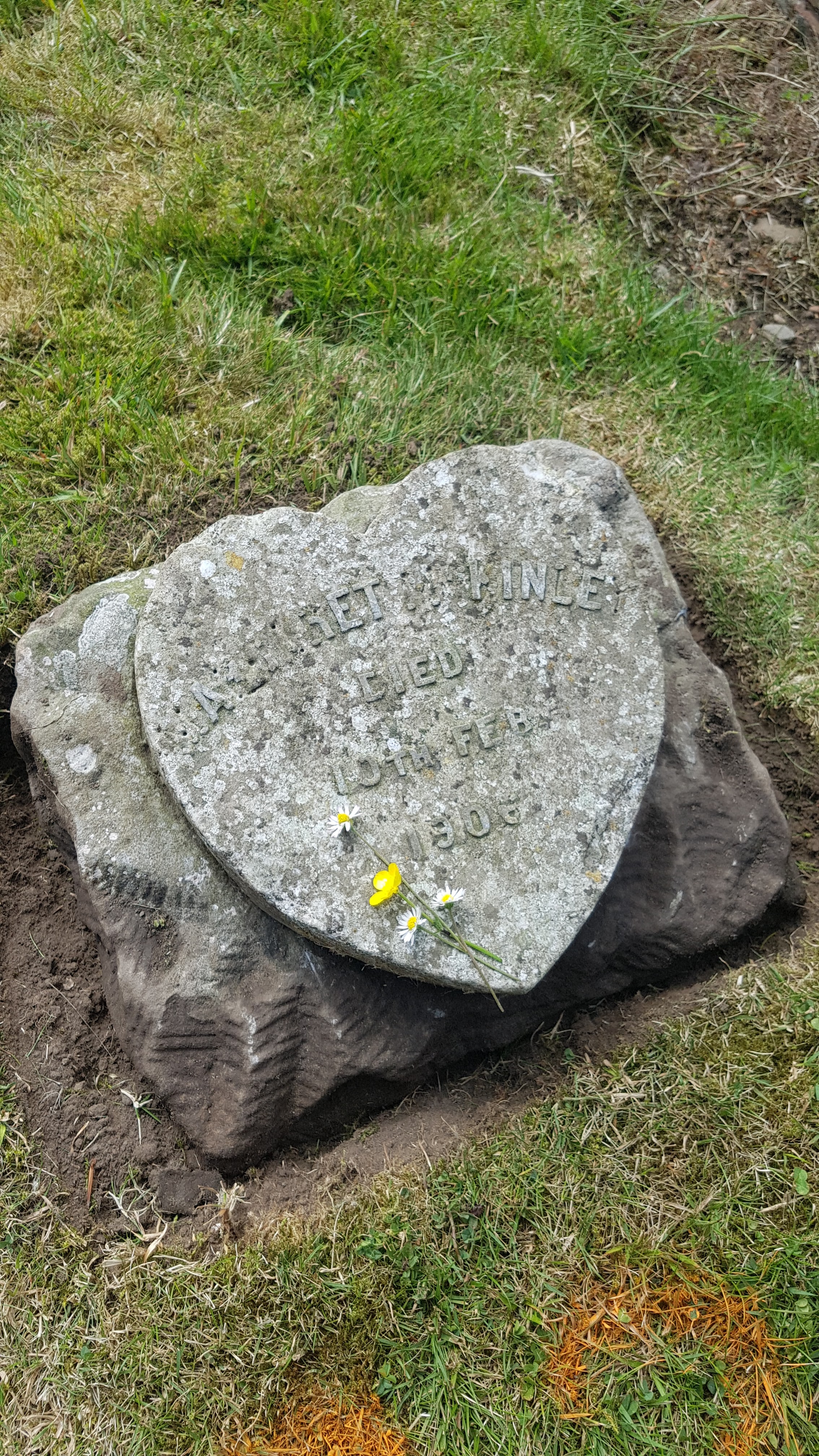
I enjoyed my wander around Ayr (Scotland) cemetery.  It was actually more than an idle wander around. I had visited previously in 2018 and found the marker for my 3xgr-grandmother at the base of the headstone of a family I could not connect to our family.  Subsequent emails with the Council revealed it had actually been relocated (unintentionally) from its original place marking Margaret’s burial place. Wandering (with intent) around the cemetery on my return visit this year, I started a conversation with the groundsman that led to us identifying the burial place, finding the plinth the marker stone originally rested on, and re-siting them both in the ‘right’ location. It was the most amazing and somewhat emotional afternoon. Forever grateful to Wally and his supervisor Stephen.

AI was a mystery to me but I learnt  ... that while it may have some amazing uses, for research and writing related tasks, I’m quite happy using my own brain, keyboard, and creative processes. For now.

The best value I got for my genealogy dollars was ... … a five day photographic pass to West Yorkshire Archives.  I spent three amazing days at the West Yorkshire Archives Service; two of them delving into the West Riding Registry of Deeds at the purpose-built West Yorkshire History Centre in Wakefield. I can’t remember how much it cost, but it enabled me take unlimited photographic copies of pages and pages of deeds related to my ancestors to bring back to Australia and peruse and interpret at leisure. Much more time efficient than trying to read and transcribe on site.


It felt good to contribute to  ... 
he ongoing development of Heritage Noosa, a website providing a one-stop shop for historic images and a myriad of other digitised material documenting the people, places and events of Noosa Shire (in my professional capacity)

It was wonderful to catch up with genimate Ian Stevenson of the Huddersfield & District Family History Society (Yorkshire, England) and have another great day out with him.

I wouldn't be without this technology ... c
loud based storage of all my scanned photos and family history notes and records. My trusty laptop is usually within arms’ length but for the odd occasion when I’m out and about without it, being able to pull something up on my phone is super handy.

I wrote ... pretty much nothing all year. But I did plenty of hunting and gathering and had lots of experiences that will lead to more writing.

I got a thrill from opening someone's eyes to the joy of genealogy ... joy would be overstating the case but having someone change their perspective on participating will hopefully lead to great joy.

Another positive I would like to share is ... how much I love geneasurprises, those spontaneous serendipities, that continue to occur in parallel with 'proper' research. The chance google that nets you a priceless family treasure, the overheard snippet of conversation that leads to a great connection, the random stranger who contacts you via your blog… all stories too long to tell here. Some I’ve already documented on my blog; others from 2023 will appear in forthcoming posts.

Now on with 2024….

Monday, 7 February 2022

A Fantastic Find

ANCESTOR HUNTING AT THE MARKETS

One Saturday morning a couple of years ago, in the interests of doing something ‘different’, I cajoled my sister and daughter into visiting Collectorama, a collectables show advertised in our local newspaper.  We weren’t really sure what to expect and it never entered my mind that the markets could play a role in my family history research.  Upon arrival, we were surprised at the size and scope of the show and spent a fascinating morning wandering the stalls that were laden with vintage jewelry, heirloom china, colourful carnival glass, lacy doilies, rusted tools, toys, books and more. 

The item that most captured my attention, however, was an aged, but intact, photo album dating, I estimate, from the mid-to-late 1800s. It had heavy covers and thick cardboard pages with cutouts into which photos could be inserted.  The album was filled with dozens of well-preserved carte-de-visites, many of them bearing photographer’s imprints from Huddersfield (Yorkshire, United Kingdom).  I spent a long time flipping the pages and chatting to the stallholder about its origins -  as someone whose most cherished possessions include old family photographs, I was affronted at the thought of someone casting off such a treasure trove of ancestors.  I was even more alarmed by the fact that the stallholder knew the gentleman it belonged to, a man named Brown who lived locally.   My family historian’s ‘radar’ was buzzing and I debated long and hard whether I could justify spending the $80 asking price to protect this album from falling into the ‘wrong hands’ (just whose these would be I’m not sure).  Having been raised to be frugal and not make frivolous purchases, I walked away without the album – it seemed highly indulgent to spend that much money on someone else’s family history.  But the memory of it stayed with me….

Not long afterwards, I began researching my Dow family, a maternal branch of my family tree that I had not previously explored.  Imagine my dismay when I discovered that my great-great-grandmother was Martha Ann Brown of Huddersfield, Yorkshire.  Admittedly, Brown is a common surname and I have no evidence of any of “our” Browns ever coming to Australia; nonetheless I was kicking myself for not having bought the album and resolved to do so at the next Collectorama if it was still for sale.   

On our return visit to Collectorama, although I found browsing the stalls equally enjoyable, I was somewhat distracted by my quest for ‘The Album’.  Nearing the end of our visit, not having found it (we have since discovered that each show features a varying range of stallholders), I was feeling a bit deflated and was standing idly by a stall while my sister and daughter engaged in a long discussion regarding some intriguing object.  To pass the time, I began flipping through an old cigar box filled with postcards.  Why? I have no idea.  I had (and I use past tense on purpose) no particular interest in old postcards or in cigar boxes.  Midway down the stack was a postcard lying address side up.  My eye was immediately drawn to the name of the addressee – Dow, the name I had most recently been researching.  Probably just a coincidence.   Regardless, I looked more closely and noted the town of address was Maryborough (Queensland).   Our Dows were from Maryborough!   My interest decidedly piqued, I checked the street – Queen Street. That’s where “our” Dows lived.    Trying to contain my excitement, I scanned back to the name – Miss E F Dow – my very own great-aunt Eva.  This was a postcard actually sent to my ancestor over 100 years ago.


Needless to say, I was completely dumbfounded and really didn’t know quite how to react to this amazing discovery.  So I held on tightly to the postcard, tried to remain calm, and began carefully sorting through the remainder of the items in the box.  The other postcards had been removed from an album and had brown paper stuck to the back and did not appear to have been written on.  But towards the bottom of the box were two photographs, both in pristine condition.  One featured two young ladies attired in matching dresses and pearl chokers.  These girls were unmistakably my great-grandmother Francia Dow (whose romance with her future husband Fred McKinlay was featured in Issue #4 of Inside History) and her sister Eva Faenza as teenagers.  The photographer’s imprint “A. R. Fosbrooke, Maryborough” provided additional support for my belief that this photo was of our family members.  The other photo, a portrait of a handsome young man, was taken at The Royal Studio, Belfast (Ireland).  With no known Irish connection in this branch of the family, I could not readily discern any family connection to this gentleman.  The only other items in the box were a couple of old pieces of correspondence relating to the Mosman Cricket Club, which I (possibly foolishly) discounted as of no relevance to our family.

Barely able to contain my jubilance, I inquired as to the price of photo and postcard and was told $2.00 per item.  Fearing the price would go up if I revealed the value of the items to me personally, I paid first and told the stallholder the story second.  She was disappointingly unenthused by our amazing tale but did manage to capitalize on our good fortune by convincing me to buy the photo of the Irishman ‘just in case’.    It was only later that I really began to ponder on just how these items had ended up on a market stall and to whom they had been important enough to keep safely for over 100 years.   I was able to contact the stallholders to see if they could recall anything – discouragingly, they had little information to provide other than ‘most likely a garage sale on the northside’ (of Brisbane).  But the story doesn’t end there. We have continued to make regular visits to Collectorama and, headed off one Saturday morning in May 2010.  Had she still been alive, it would have been my Granny Mavis (nee McKinlay) Davey’s 101st birthday.   We had barely begun our tour of the stalls when we found ourselves at the very same stall from which we had purchased the photo and postcard twelve months earlier.  There, lying on the table, surrounded by other bulkier objects, was a lone photo, featuring a girl in costume, dressed as Rule Brittania.  I immediately recognized it as a picture that hangs on my mother’s living room wall.  Almost incoherent with incredulity, I rang Mum, tripping over my words as I asked her to describe some details of her picture to make sure I wasn’t completely imagining it.  I’m sure my excited babbling was a source of great amusement to nearby shoppers.  There was no doubt it was the same picture and, this time, the stallholder gifted the photo to us.Although we had previously believed the picture to be of Granny Mavis (whose birthday it was), this discovery prompted us to study it more closely and we ultimately determined that it is actually her mother, Francia, and was most likely taken around the time of Queen Victoria’s Diamond Jubilee in 1897.  The Jubilee was widely celebrated in Maryborough where Francia grew up and in honour of which Francia was awarded a memorial scholarship[i].  Regardless, we were thrilled to have another copy of this picture.


The chances of finding (and recognizing) photos of your ancestors on a market stall are slim and the chances of being this lucky twice, even slimmer.  My family assure me I have used up my serendipity and should quit while I’m ahead but it’s only made me more enthusiastic in my perusal of market stalls and more dogged in my examination of postcards and photos.  Someone kept these photos safe for over 100 years – who knows what other stashes of family photos may be lurking in the garages of strangers, just waiting for me to find them. When it comes to family history, I’m learning never to say ‘never’.

This article was first published as 'Lost, then found' in Inside History Magazine, Sept-Oct 2011

[i] The Brisbane Courier, Tuesday 8 February 1898, p. 5


Saturday, 9 January 2021

Let's Start at the Beginning


52 Ancestors in 52 Weeks (2021)
Week 1 | Beginnings

The 'Rothesay Bay'
As an Australian of European descent, all the branches of my family tree have their roots in faraway lands and were transplanted here with the hope of new beginnings.   The desire to know who my immigrant ancestors were, where they came from, when and where they arrived, and under what circumstances was the spark that ignited my family history adventures several decades ago.   This week’s theme has challenged me to collate these details into one concise(ish) summary, something I’d not yet done.  The end result is a group of 33 direct ancestor immigrants;  – from gr-grandparents to 4xgr-grandparents; the earliest in 1840, the most “recent” in 1886.   Some who came as single young adults, some as children with their parents, and some as older couples following their adult children.   From England, Scotland, Ireland, France and Germany.  To South Australia, Victoria, Queensland and just one to Tasmania (and this one not by choice).

So, let’s kick off the new year by meeting these brave and resilient folks who gave my family their beginnings in Australia.

In clockwise order around my Fan Chart (and, please note, this is a very ‘names and dates only’ post – their stories will be the fodder of future posts).

MATERNAL

Catherine Elizabeth Simpson and her sisters
Catherine Elizabeth Simpson (2xgr-grandma) and her parents John and Ellen (nee Hodgson) Simpson (3x gr-grandparents) who came from Rawcliffe, Yorkshire in 1864 along with five of her ten siblings and settled in Maryborough (Queensland).

Louis Henry Dow (gr-gr-grandpa):  Finding himself an orphan at the age of 19 years, Louis left Lockwood, Yorkshire and arrived in Maryborough (Queensland) in 1879, where he married Catherine Elizabeth Simpson in 1881.

Margaret Ann Stewart (gr-gr-grandma), an Irish servant girl from Co Antrim, Ireland who sailed alone to Australia in 1876, settling in Rockhampton (Queensland) where she married Scotsman John McKinlay in 1878.  The couple and their four children moved between homes in Rockhampton and Emu Park.

John McKinlay (gr-gr-grandpa), of Ayrshire, Scotland arrived in Rockhampton in 1876 where he had a long career as an engineer and raised his four children with Margaret Ann Stewart.  Two of his brothers and one sister also emigrated to Australia and a third brother to New Zealand.

Elizabeth Betts (gr-grandma), one of eight children of Richard John DeVere and Tracey (nee Goodgame) Betts of Oxfordshire, arrived in Australia in 1886, settling in Queensland. She married Henry Davey in 1889.  Several of her siblings also emigrated to Australia. 

Henry Davey (gr-grandpa) purportedly born in Wedmore, Somerset, arrived in Queensland in 1884, settling in the Lutwyche (Brisbane) area where he forged a career as a painter and decorator.  He married Elizabeth Betts in 1889 and the couple had two children.

PATERNAL

Ellen Boyne (3x gr-grandma) was born circa 1835 in Scotland (most likely in Invernesshire). She began her life in Australia in 1852 as a 27 year old domestic servant. A few months after her arrival in Melbourne, she married former convict Charles Plant in Scots Church.  Ellen featured in a blog post in March 2018.

Charles Plant (3 x gr-grandpa) is the only one of my ancestors whose ‘beginning =’ in Australia was imposed upon him by the British courts, having been convicted in the Cheshire Court of Petty Sessions in 1842 of stealing 7 pairs of stockings.  He served time  in Van Diemen’s land, making his way to Melbourne following the issue of his Ticket of Leave. Ellen and Charles had seven children, three of whom lived to adulthood, and lived a hard life in and around the goldfields of central Victoria.

Wilhelmine Jackel (3x gr-grandma) was born circa 1831 in Germany and married Johan Christian Westendorf in 1856 at St George’s Church, Gawler, South Australia. Her arrival in Australia is subject to further research but was possibly on the Adele  which arrived in Port Adelaide from Hamburg on 14 September 1856.  If this is the correct shipping record, she was 24 years of age and travelled as a single woman.

Joachim Heinrich Westendorf (4x gr-grandpa) and Luise Schonfeld (4 x gr-grandma) and their six children, including son Johan Christian Westendorf (3 x gr-grandpa) arrived in South Australia aboard the Suzanne in 1851.  Within a few years, they had moved to the Western district of Victoria.

Jesse and Harriet (nee Stone) Heal (3x gr-grandparents) (pictured at left) were born and married in Somerset, where Jesse worked as a gardener.  They arrived in Victoria in January 1857 aboard the William, along with three of their children, including daughter Rosina Heal (2 x gr-grandmother). A fourth child was born after their arrival and the family lived the Stawell district of Victoria.

Edward Jory (2x gr-grandfather) was born in Cornwall in 1839 and arrived in Victoria as a 24 year old single man aboard the Result in 1863.  He travelled around the goldfields working as a lay preacher before marrying Rosina Heal in 1870 and settling in Natimuk where the couple had a general store.

Robert and Jane (nee Moon) Lucas (4xgr-grandparents) arrived in Adelaide from Wiltshire aboard the Fairfield in December 1840 along with a number of their children, including daughter Jane Lucas.

Charles Mathurin Leon DeLaine was born as Charles Mathurin Leon Laine in Etretat, Le Havre, France on 7 February 1818.  His arrival in Australia is cloaked in folklore but the latest research indicates he walked off a whaling ship in New Zealand in 1836.  The details of his arrival in South Australia are still to be determined. He married Jane Lucas in 1843. (More of his story in blog post dated 8 February 2018)

David and Emma (nee Hill) Mills (3xgr-grandparents) were born and married in Wiltshire and arrived in South Australia aboard the Sibella in July 1848 along with several of their children, including son George Mills (2xgr-grandfather).

Emma’s parents Thomas and Rachel Hill (4xgr-grandparents) arrived in Australia the following year aboard the Ramilles  along with several of their children.

David’s parents John and Mary (nee Ingram) Mills (4xgr-grandparents) arrived aboard the Oriental in November 1855 with their son Job and daughter MaryAnn.

Anthony Nicholson (Ruddick) Teasdale (2xgr-grandfather) remains somewhat of a mystery man, not the least of which is his change of last name from Ruddick to Teasdale.  He was in South Australia by the time he married Agnes Sprott Wilson (2xg-grandmother) in 1869.

Hugh and Margaret (nee Grant) Wilson (3x gr-grandparents ) arrived from Scotland in South Australia from Scotland in 1862 aboard the Castle Eden along with their children, including daughter Agnes Sprott Wilson (2x gr-grandmother).

Sunday, 12 January 2020

Siblings


52 Ancestors in 52 Weeks (2020)
Week 2 | Favourite Photo

Is it possible to have just one favourite photo? I’m fortunate to have a large collection of photos of my ancestral families and many are favourites for different reasons.  So I thought I’d treat this week’s challenge like a question in a Myers Briggs test and go with the first photo that popped into my mind when I read the topic. 


This photo features my granny, Mavis McKinlay, age 12 years, with her younger sister Rae and brother Jock, posed in their father’s Model T Ford.  The three siblings, the children of school teachers Frederick and Francia (nee Dow) McKinlay, were frequently photographed as a trio and generally appeared to be the best of friends, enjoying being photographed together.  When I revisited this photo to write this post, I was surprised to find that they don’t quite look their usual chipper selves.  Mavis is staring down the camera in a very direct way, almost glaring (which, in fact, is quite characteristic of her) and Jock looks a bit sceptical altogether. 

The photo was taken in January 1922 in Hamilton Creek (an outlying community of Mt Morgan in central Queensland) and, given this timing and the badge on Mavis’ hat ribbon, may have been taken on the first day of school for the year.   By this time, Mavis had commenced her secondary school education at Mt Morgan High School, while Rae and Jock would have still been attending Hamilton Creek State School, where their father Fred was head teacher.

This photo is made more of a favourite due to some snippets of priceless information I received a few years ago that adds a dimension to the story that the photo tells.  Mt Morgan High School celebrated its centenary in 2012 and I obtained a copy of the book published for the anniversary.  In it was an article about a former student, who I calculated would have attended the school at the same time as Mavis, who, somewhat surprisingly,  was still alive.  This seemed pretty remarkable and I was immediately keen to see if I could meet him and if he would remember my Granny.  Remember, family history is all about the long shot.  I contacted the school centenary committee who put me in touch with his daughter (who had submitted the article) and discovered that this gentleman was residing in an aged care facility only an hour’s drive from my home. I arranged to visit despite the daughter indicating that she didn’t think he’d remember much.  And I’m so glad that I did.  Not only was it an absolute treat to meet 103 year-old Lyle, but once I was there in person and mentioned the McKinlay name, he immediately said ‘Oh yes! McKinlay! He was the school teacher chap. Drove his daughters to school every day in his Model T Ford’.  He couldn’t add much more detail than this but I was thrilled.

It’s a seemingly tiny detail but a lovely qualitative piece of information, obtained firsthand, to add to the family story and to the context of this photo.  I feel quite pleased to know that my gr-grandfather drove my granny to school every day and that he was an involved and presumably kind father.  And, given that Lyle remembered this detail  90 years later, suggests that getting driven to school was not a very common occurrence in Mt Morgan at that time.

So what did life hold in store for this trio? Here’s their very brief bios.

Mavis (1909-1984), academically talented and a competitive swimmer, followed family tradition and trained as a teacher.  After a few years doing relief teaching, she married World War I veteran Ernest Frank Davey and raised six children on a small crops farm in Eight Mile Plains, near Brisbane.

Rae (1909-1991) also trained as a teacher and worked briefly prior to her engagement and marriage to Leslie Lyon Bell.  The couple lived in Brisbane and had one daughter. 

Jock (1915-1954) trained as a pilot in the RAAF and received a commission to the RAF in 1937 which found him in England when World War II broke out.  After several years’ active duty with the RAF in Bomber Command and as an instructor in the Empire Air Training Scheme, Jock returned to Australia and continued serving the war effort flying Catalinas for the RAAF.  After the war, he married his childhood sweetheart (and first cousin) Jean McKinlay.  He died tragically in 1954 in an industrial accident, leaving his devastated wife with four children under the age of seven years.

Sunday, 18 February 2018

Scandal in Broadmount

52 Ancestors in 52 Weeks | Week 7 - Valentine
#52 Ancestors

Francia Dow, 1904
Any number of love stories from our family tree spring to mind in response to this week’s theme. There’s great-aunt Jean who married her childhood sweetheart (who was also her first cousin) amidst much family disapproval; great-great aunts Eva and Annie who never married after losing beaus in World War I; and my grandma Rosina who lost her handsome husband far too soon. But I’ve chosen my great-grandmother, Francia Dow (1884-1943) whose romance with my great-grandfather caused a brief, but rather intense, scandal in a small central Queensland community in 1906.

Francia was born in 1884 in Maryborough (Queensland) the second of six children of Louis Henry and Catherine (nee Simpson) Dow. She excelled academically in her primary education at Albert State School and was awarded a scholarship to Maryborough Grammar School in 1898. Francia then undertook teacher training and, at the age of 19 years in 1903, was admitted as a teacher by the Department of Public Instruction. Teaching offered an honourable and profitable career to educated women at this time and with steadily rising numbers of children of school age, female teachers were increasingly utilized by the Department. There was no teacher training college in Queensland at the turn of the century and teachers were recruited and trained through the pupil teacher system. Although no records have been located, this is presumably how Francia received her training.

Francia’s first posting was to Broadmount Provisional School. Broadmount was a small, and quite isolated, port community on the Fitzroy River east of Rockhampton. The population of Broadmount was never large and dwindled as use of the port was scaled back. In 1906, the Broadmount Provisional School was closed due to small attendance numbers.  

The community was upset by the closure of their school and local businessman, Robert Fleming, sent an angry missive to the District Inspector, Thomas R. Brown. For reasons that remain unclear, much of his ire was directed at Francia, with accusations of ‘falsehoods’, ‘hoodwinking’, and ‘carrying on during school hours’. He further intimated that Francia had in some way orchestrated the closing of the school and that a gross impropriety had taken place in Francia receiving 6 weeks holiday rather than the standard 5. He asserted that this alleged misconduct was a result of ideas having been “put into her head by a young man a school teacher in the Leichardt School Rockhampton” (Robert Fleming, February 13, 1906).

The young man to whom he referred was Frederick McKinlay, another of the district’s school teachers. He was also a friend of the Dow family and, more importantly, he was Francia’s fiancĂ©. Mr. Fleming goes on to allege that:

…this young man has been in the habit of riding down to B’Mount very near every week end, and as our teacher is living in a cottage far separated from any other house, every one can draw their own conclusions where he stops… now sir do you think such carrying on is right with young people especially teachers of young children (Robert Fleming, February 13, 1906) 

Mr. Fleming also asserts that Francia's farewells to this young man on the wharf at the end of these weekend visits were too fond.   

Fortunately, Francia appears to have had an ally in the District Inspector, Mr. Thomas Brown, who gave the young couple an opportunity to respond to the charges, accepted their representations, then staunchly supported them in defense of the allegations against them.

Although Mr. Brown had indicated that he would not involve Francia’s father, Fred happened to meet up with him, informed him of the matter and Louis lost no time in penning a letter in support of his daughter and her fiance:

I have the honour to state that my daughter is engaged to be married to Mr. F. McKinlay with my consent and her mothers. I have been acquainted with the fact that Mr. McKinlay has visited Broadmount every weekend and have quite approve [sic] of his having done so.  Mr. McKinlay will inform you of my wishes in the matter.  I have known Mr. McKinlay for sixteen or seventeen years and have always considered him and his family as most intimate friends. (Louis H Dow, March 2, 1906) 

Mr. Brown’s response to Mr. Fleming took a firm stance, urging that:
It will be well I think to consider separately what you say with reference to Miss Dow in her capacity as teacher, and the very serious reflections you make on her honour and reputation as a woman.
He closed the matter by stating:
In the present state of my knowledge of these matters I come to the conclusion that there are no substantial grounds for your charges and insinuations, and no call for further inquiry unless fresh facts are laid before the Ministers.  (Thomas R. Brown, District Inspector, 1 March, 1906)

Francia Dow and Frederick McKinlay
on their wedding day in 1908
Fortunately, nothing further appears to have come of this matter. Francia moved on to her next posting, Mt. Chalmers Provisional School where she taught for several years. Fred and Francia were married in 1908 and had three children – Mavis, Rae and Jock. Fred continued to teach at various schools around central Queensland, ably but unofficially assisted by Francia (as she was required to resign her position upon her marriage), until his death in 1936.

The events of 1906 were but a small chapter in Fred and Francia’s lives (albeit no doubt quite distressing at the time). For me, reading about it in school correspondence files over 100 years later, I was given a glimpse of my great-grandparents as typical young couple in love, finding opportunities to be together whenever and however they could.